Enciphering
The last type of monoalphabetic cipher we’ll cover is the Affine Cipher. The name affine comes affine functions, which are linear functions with a constant term. For example, to map plaintext to ciphertext in a 26 letter alphabet, we would use the following affine function:
where is the numerical value of a plaintext letter, is a valid multiplicative key, is a valid additive key, and is the numerical value of a ciphertext letter. Notice you use the multiplicative key first, then the additive key, then by 26.
Example
Let’s look at enciphering the plaintext, unicorn with m = 7 and a = 16
 plaintext:   u    n    i    c    o    r    n
 numerical:  20   13    8    2   14   17   13
        x7: 140   91   56   14   98  119   91
       +16: 156  107   72   30  114  135  107
    MOD 26:   0    3   20    4   10    5    3
ciphertext:   A    D    U    E    K    F    D
Notes on Keys
Since we’re still multiplying as part of our algorithm, only the valid multiplicative keys we discovered in the previous section can be used. If we choose m = 1, this is essentially a Caesar Cipher, since multiplying by 1 does not change the value of .
Like with the multiplicative cipher, we can visualize the transformation from plaintext to ciphertext graphically by plotting the points with integer values on the line .
import numpy as np
import matplotlib.pyplot as plt

plt.style.use('seaborn')

def f(P, m, a):
    return (m*P + a)%26
t1 = np.arange(0, 26, 1)
plt.xticks(np.arange(26), ('a', 'b', 'c', 'd', 'e', 'f', 'g', 'h','i', 'j', 'k', 'l', 'm', 'n', 'o', 'p', 'q', 'r', 's', 't', 'u', 'v', 'w', 'x', 'y', 'z'))
plt.yticks(np.arange(26), ('A', 'B', 'C', 'D', 'E', 'F', 'G', 'H','I', 'J', 'K', 'L', 'M', 'N', 'O', 'P', 'Q', 'R', 'S', 'T', 'U', 'V', 'W', 'X', 'Y', 'Z'))
plt.grid(True)
plt.gca().set_aspect('equal', adjustable='box')
plt.axis([-1, 26, -1, 26])
plt.xlabel('plaintext')
plt.ylabel('ciphertext')
plt.title('m = 7, a = 16')
plt.rcParams["figure.figsize"] = (6,6)
plt.plot(t1, f(t1, 7, 16), 'o')
plt.show()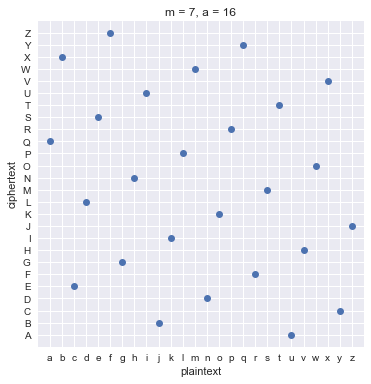
Deciphering the Affine Cipher
To determine how to decipher a message that was encrypted using the Affine Cipher, let’s solve the affine function from earlier for in terms of . Remember, we won’t divide by when working in modulo 26, we’ll multiply by the multiplicative inverse of , denoted as .
So, to decipher a message, you’ll take the numerical value of each ciphertext letter, first subtract from it, then multiply by the multiplicative inverse of , and lastly by 26.
Example
Let’s now decipher our test message with ciphertext ADUEK FD with m = 7 and a = 16. We’ll first need to determine the multiplicative inverse of 7 in modulo 26. You may recall from the section on Multiplicative Ciphers that the inverse of 7 is 15, which we can confirm because and .
ciphertext:    A     D     U     E     K     F     D
 numerical:    0     3    20     4    10     5     3
       -16:  -16   -13     4   -12    -6   -11   -13
       x15: -240  -195    60  -180   -90  -165  -195
    MOD 26:   20    13     8     2    14    17    13
 plaintext:    u     n     i     c     o     r     n
Exercises for the Reader
Can you write Python code to encipher and decipher messages using the Affine Cipher?
How many unique ways could you encipher a message using an Affine Cipher? Asked another way, how many key pairings are there?