We’ve seen that it’s not easy, or even possible, to match up every ciphertext letter with its plaintext counterpart based solely on frequency. But what if you could get one or two matched correctly?
Cracking Affine
Suppose we have the following ciphertext which we believe to be enciphered using the Affine cipher and unknown keys. This is the same text from the last section, only shortened for simplicity.
ciphertext = 'KRETI JUKRP TUCHI GRDPT UHUJK XUDET IVVKP RIPER EYPWD KHPWO UPTIJ ULKJJ UDOKP TPTUU RDYIL OIHAY ERDER IINWY AUJJR IHWUP EDHWV EHUYE RDWTI JUOKP TRIPT KRCKR KPPIY KPDIO RIRIH PIUEP KPOEY ETIVV KPTIJ UERDP TEPAU ERYMI ALIHP'Looking at the frequency distribution:
from seaborn import barplot

def textClean( text ):
    LETTERS = 'ABCDEFGHIJKLMNOPQRSTUVWXYZ'
    text = text.upper()
    cleaned = ''
    for char in text:
        if char in LETTERS:
            cleaned += char

    return cleaned

def letterFrequency(text):
    text = textClean(text)
    frequencyList = []
    LETTERS = 'ABCDEFGHIJKLMNOPQRSTUVWXYZ'

    for char in LETTERS:
        frequencyList.append( 100 * text.count(char) / len(text))

    return frequencyList

labels = ['A', 'B', 'C', 'D', 'E', 'F', 'G', 'H', 'I', 'J', 'K', 'L', 'M', 'N', 'O', 'P', 'Q', 'R', 'S', 'T', 'U', 'V', 'W', 'X', 'Y', 'Z']
values = letterFrequency(ciphertext)
barplot(labels, values, color='steelblue');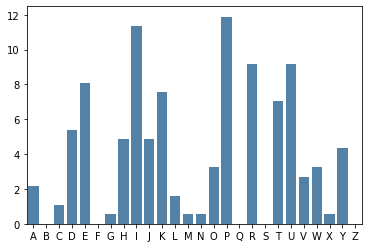
We can see that P, I, R, and T are the most common letters in the ciphertext. Since e is the most common letter in English, let’s suppose that the ciphertext letter P was enciphered from the plaintext letter e.
We know that the ciphertext letter was enciphered using the formula:
where is the multiplicative key that is relatively prime to 26 and is the additive key. Our guess that e enciphers to P implies that when (an e) (a P). Evaluating the encipher equation with these values yields:
This equation alone is not enough to determine and . You will need the same number of equations as unknown to be able to solve the system, so you’ll need to make a second guess to determine a second equation. Since T is the second most frequent letter in the English alphabet it would be reasonable to assume that ciphertext letter I was enciphered from the plaintext letter t, since I is the second most frequent letter in the ciphertext. Following the same procedure as earlier yields the second equation:
We can solve the system of congruences:
To solve this system of linear equations, we’ll employ the elimination method by subtracting multiplies of one equation from another to generate a new equation. In this case, subtracting the second congruence from the first one eliminates , resulting in a congruence with only one unknown:
and since we know:
Multiplying both sides by the multiplicative inverse of , which is 19, we find:
and so
Solving for :
Unfortunately, when we use these values for akey and mkey, we don’t get a readable plaintext:
def affineDecipher(text, akey, mkey):
    ciphertext = textClean(text)
    LETTERS = 'ABCDEFGHIJKLMNOPQRSTUVWXYZ'
    plaintext = ''
    minverse = -1

    for testinverse in range(0,26):
        if (testinverse * mkey) % 26 == 1:
            minverse = testinverse

    for char in ciphertext:
        plaintext += LETTERS[ minverse * (LETTERS.find(char) - akey) % 26 ]

    return plaintext.lower()
print( affineDecipher( ciphertext, 3, 3 ))lwjotcxlweoxrktbwaeoxkxclyxajotgglewtejwjhepalkepvxeotcxulccxavleoeoxxwahtuvtkzhjwajwttmphzxccwtkpxejakpgjkxhjwapotcxvleowteolwrlwleethleatvwtwtketxjelevjhjotggleotcxjwaeojezxjwhdtzutke
So, what went wrong? In the original, unenciphered message, there’s an unusually high amount of the plaintext letter o and an unusually low amount of the plaintext letter e. There was no way for you to know this (the plaintext is by nature secret when deciphering), and as a result, your guesses of and were incorrect. Incorrect guesses will either lead to incorrect deciphering of the ciphertext or invalid values for (values that are not relatively prime with 26).
Let’s readjust our guesses to reflect this information so and which results in the following solution:
Subtracting the second equation from the first:
which is equivalent to:
Multiplying by the inverse of , which is 5.
and so:
Solving for :
Attempting to decipher with a multiplicative key of 17 and additive key of 4 yields the following plaintext:
print( affineDecipher( ciphertext, 4, 17))inaholeinthegroundtherelivedahobbitnotanastydirtywetholefilledwiththeendsofwormsandanoozysmellnoryetadrybaresandyholewithnothinginittositdownonortoeatitwasahobbitholeandthatmeanscomfort
Which we can see is the phrase:
In a hole in the ground there lived a hobbit. Not a nasty, dirty, wet hole, filled with the ends of worms and an oozy smell, nor yet a dry, bare, sandy hole with nothing in it to sit down on or to eat: it was a hobbit-hole, and that means comfort.
As long as you can guess two pairs of corresponding plaintext and ciphertext letters, this method will determine the correct additive and multiplicative keys to map the two together.